
A hardwood floor's price is set by the wood you choose, the labor to install and finish it, and the prep the subfloor needs first. The wood alone covers a wide range, because species, grade, width, and construction all move the number, and in a damp climate the prep and acclimation are real line items rather than afterthoughts. Here is what actually drives a hardwood quote, without a per-square-foot price that will be stale in a year.
Where the Money Goes on a Hardwood Floor
Three parts make up a hardwood quote: the material, the installation labor, and the prep. Material is the wood, plus underlayment and any moisture barrier. Labor is measuring and setting the boards and, if the floor is finished on site, sanding and coating it. Prep is leveling and repairing the subfloor, checking it for moisture, and letting the wood acclimate to the house before a board goes down. The finishing and the prep can each rival the cost of the wood, and skipping either is how a floor cups, gaps, or fails its warranty, so the cheapest bid is rarely the one that leaves them out.
How Species and Hardness Change the Price
Species is the biggest single lever on wood cost, and hardness is a good proxy for it. The industry measures hardness with the Janka test, which presses a small steel ball into a board and records the force it takes. Red oak, the North American benchmark, rates about 1290; softer or common woods sit near or below that, and harder ones climb above it. Hard maple lands around 1450 and hickory around 1820, while American black walnut, prized for its color rather than its toughness, is softer at about 1010. Harder and more sought-after species generally cost more to buy, and because they are tougher on blades and sandpaper, they can add a little to labor as well.
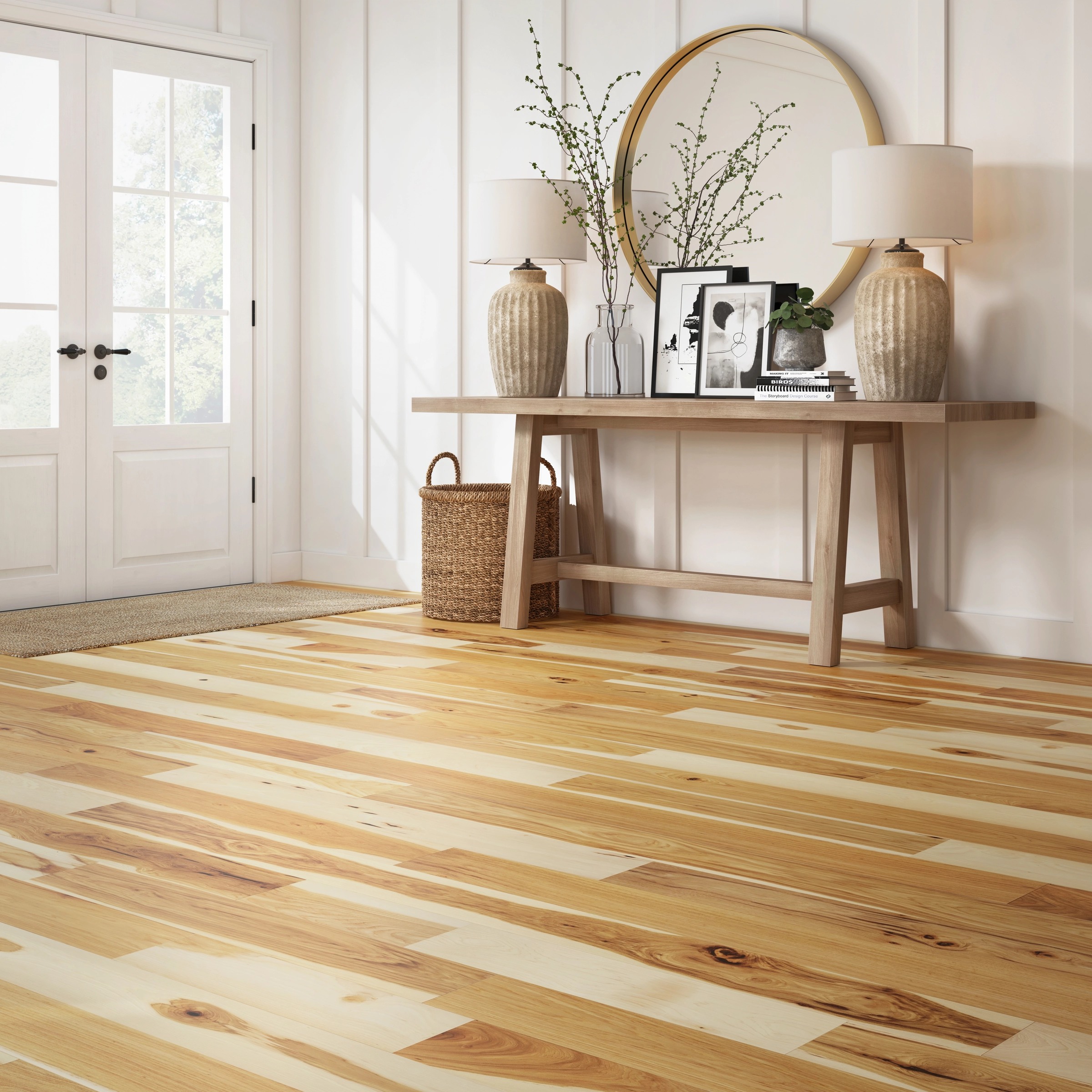
Grade moves the price too, and grade is about looks rather than strength. A clear grade, with even color and few knots, costs more than a character or rustic grade that shows knots, streaks, and color variation. Neither is stronger than the other, so if you like some character in a floor, a lower grade genuinely saves money without giving up durability.
Solid vs. Engineered, and What Each Costs
Solid and engineered hardwood sell in the same price range, but which one fits your house can change the total. Solid hardwood is one piece of wood through and through, and it can be sanded and refinished many times over its life. Engineered hardwood is a real-wood top layer over a plywood-style core, which holds its shape better against moisture and can go over concrete slabs and below grade where solid wood struggles. In a wet climate the right construction is often engineered, and choosing it can save on subfloor and moisture work even when the plank itself costs about the same.
Choosing between solid and engineered comes down to what is under the floor and how wet the space gets. We walk through that decision for our own market in our guide to engineered hardwood in the Bellevue area, and the short version is that the subfloor usually decides. Getting that choice right up front keeps a floor from failing, which is the most expensive outcome of all.
Plank Width, Finish, and How They Add Up
Plank width and finish are the two choices that quietly move a hardwood quote. Wide planks cost more per square foot than narrow strips, both because they use more select wood and because they need more careful setting to stay flat. Finish is the bigger swing: a prefinished floor arrives sealed from the factory and installs faster, while a site-finished floor is sanded and coated in your home, which adds labor, days, and dust but lets you match a custom color and end up with a smooth, unbroken surface. Prefinished usually installs for less; site-finishing buys you control over the color and the final look.
Why Prep and Acclimation Are Real Line Items
Prep and acclimation are billable steps on a hardwood job, and in a wet climate they carry more weight. Wood moves with the humidity around it, so the National Wood Flooring Association (NWFA), the trade group that writes the U.S. installation standards for wood floors, calls for the house to sit at a controlled 35 to 55 percent relative humidity and 60 to 80 degrees, and for the wood to acclimate to those conditions before it goes in. Rush the acclimation and a floor installed too wet will shrink and gap over its first winter, while one installed too dry will cup when summer humidity returns. That settling time is part of what you are paying for, even though nothing visible happens during it.
The subfloor adds its own prep. A wood floor needs a flat, dry, sound base, and over the concrete slabs and older crawl spaces common around Bellevue that means testing for moisture first, because vapor rising through a slab will ruin a wood floor from underneath. Leveling a wavy subfloor, fixing squeaks, and adding a moisture barrier are all real costs, and they are the ones that protect the expensive part on top.
Tear-Out, Stairs, and the Rest of the Labor
Removing the old floor and handling stairs are the labor costs people forget. Pulling up old flooring and hauling it away takes time and carries a disposal cost, and glued-down or stapled floors come up slower than a floating floor. Stairs are the other one: each tread and riser is cut, fitted, and finished by hand, so a staircase in hardwood costs far more per step than the same wood run across an open room. A quote that covers tear-out and stairs honestly is worth more than a low number that quietly leaves them out.
What Moves a Hardwood Quote Up or Down
Cost driver | Why it changes the price |
Species and hardness | Harder, sought-after woods (hickory near 1820 vs red oak near 1290 on the Janka scale) cost more to buy and to work |
Grade | Clear grades cost more than character grades; it is appearance, not strength |
Solid vs engineered | Engineered can save on moisture and subfloor work over slabs |
Plank width | Wide planks use more select wood and need more careful setting |
Finish | Site-finishing adds sanding, coating, days, and dust over prefinished |
Prep and acclimation | Moisture testing, leveling, and settling to 35 to 55 percent humidity are real line items |
Tear-out and stairs | Removal, disposal, and hand-fitted stairs add labor |
Hardwood Flooring Cost FAQs
Is engineered hardwood cheaper than solid?
Not always; the plank prices overlap, and the real savings from engineered come from the prep it can skip. Over a concrete slab or in a below-grade room, engineered hardwood often installs without the moisture workarounds solid wood would need, which can lower the total even when the board costs about the same.
Does harder wood cost more?
Usually, yes. Harder species like hickory, which rates about 1820 on the Janka hardness scale against red oak's 1290, tend to cost more to buy and are tougher to cut and sand, so labor can rise a little too. Harder is not automatically better, though; the right hardness depends on your household, your pets, and your traffic.
Is prefinished hardwood cheaper to install than site-finished?
Prefinished usually installs for less, because the sanding and finishing happen at the factory instead of in your home. Site-finished floors cost more in labor and take more days, but they let you match a custom color and end up with a smooth, unbroken surface, which is why some homeowners still choose them.
Why does acclimation add time to a hardwood job?
Acclimation adds days because the wood has to reach the home's normal humidity before it is installed, or it will move afterward. The NWFA calls for a controlled 35 to 55 percent relative humidity and 60 to 80 degrees, and letting the boards settle to that first is what keeps the finished floor from gapping or cupping later.
Getting a Real Number for Your Hardwood Floor
Pricing a hardwood floor honestly means looking at the wood you want, the rooms, and what is under the current floor. When you're ready, request a free in-home estimate and we will measure, check the subfloor for moisture, and give you a written quote with the finish and the prep spelled out. If it helps to spread the cost, we offer financing. You can see the species and constructions we carry in our hardwood catalog, and our hardwood buyer's guide covers how to choose.