
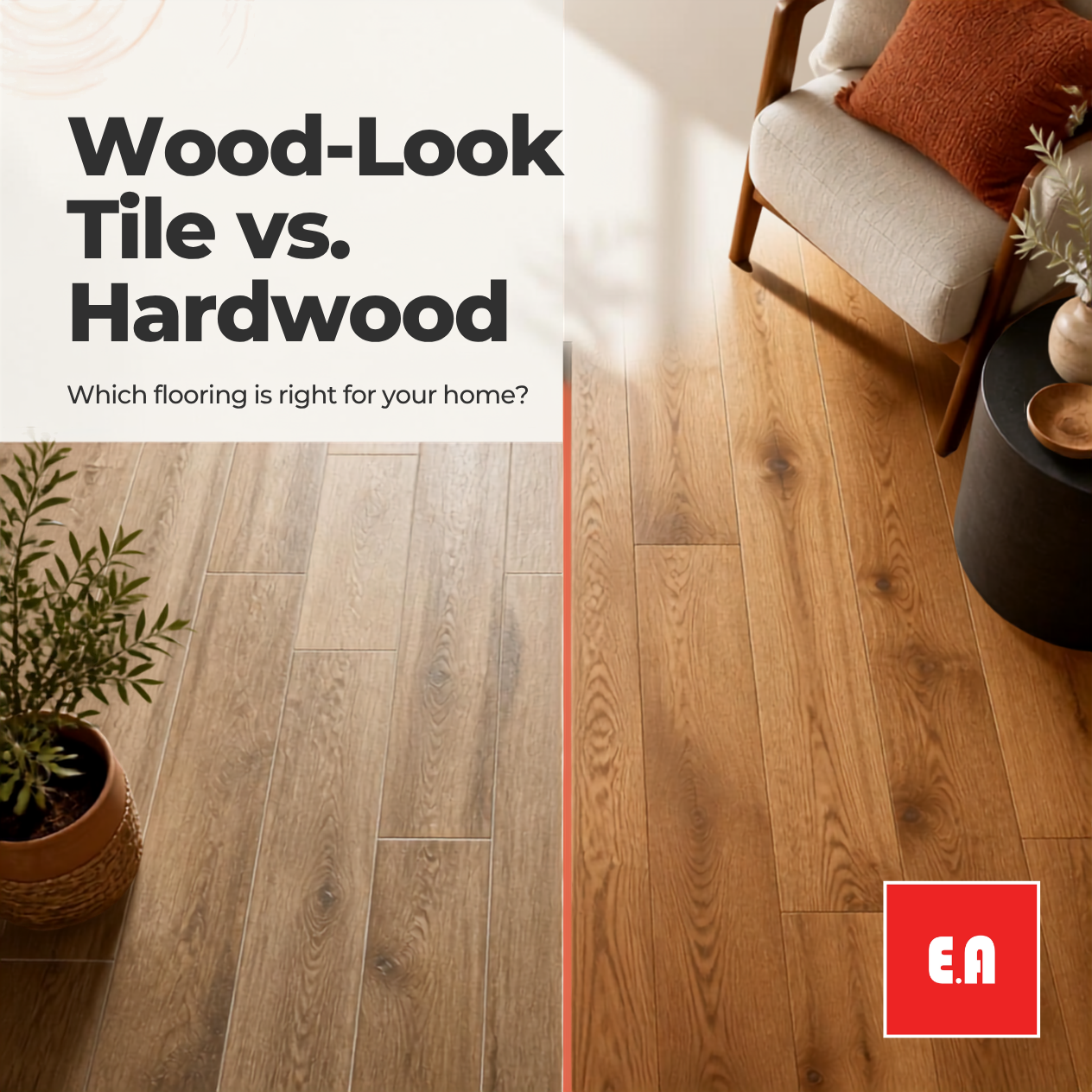
Wood-look tile and real hardwood give you the same warm, plank look and behave nothing alike underfoot or under water. Wood-look tile is porcelain, so it's waterproof and hard and belongs in the rooms wood cannot go. Real hardwood is warmer, softer, and refinishable, and it holds a value with buyers that tile does not quite match. The right choice comes down to the room: where water and hard use rule, tile wins; where comfort and long-term value rule, wood does. Here is how the two compare and how to pick between them.
What Wood-Look Tile Actually Is
Wood-look tile is porcelain tile printed and textured to look like wood planks, which means it behaves like tile rather than like wood. Under ANSI A137.1, the U.S. tile standard from the Tile Council of North America (TCNA), a tile counts as porcelain only when it absorbs 0.5 percent or less of its weight in water, and that low absorption is why wood-look porcelain can go where real wood never should: showers, mudrooms, laundry rooms, and basements. It carries a hardness grade from the ASTM C1027 abrasion test, and for wet floors it carries a slip rating the standard sets at 0.42 or higher. It looks like a board and performs like stone.
Where Wood-Look Tile Wins
Wood-look tile wins anywhere water, grit, or heavy traffic would punish a wood floor. Because porcelain absorbs almost no water, it shrugs off a wet mudroom, a kids' bathroom, a laundry, or a basement slab without cupping, staining, or swelling. It's hard enough to laugh off dog claws and dragged chairs, and a wet-area tile at 0.42 slip resistance or higher keeps its footing when the floor is wet. It never needs refinishing, and it won't fade in a sunny room the way some woods do.
Wood-look tile has real downsides worth saying out loud. It's cold and hard underfoot, so a kitchen where you stand for hours or a bedroom you cross barefoot can feel less welcoming than wood, though radiant heat underneath solves much of the cold. It has grout lines a solid wood floor doesn't, and those lines want occasional sealing and cleaning. And a chipped tile gets replaced rather than repaired, so keeping a few spare tiles from the original batch is a smart move.
Where Real Hardwood Wins
Real hardwood wins on warmth, comfort, and long-term value, and on the simple fact that you can renew it. Wood is warmer and softer underfoot than any tile, which is why it feels right in living rooms, bedrooms, and hallways. Its hardness varies by species: on the Janka scale, which measures the force to press a steel ball into a board, red oak sits at about 1290, hard maple around 1450, hickory near 1820, and black walnut around 1010, so you can match toughness to your household. Most important, a solid wood floor can be sanded and refinished many times over its life, so scratches and even a dated color are fixable rather than permanent, and buyers consistently place a premium on real wood.
Hardwood asks for conditions tile does not. Wood moves with humidity, so the National Wood Flooring Association (NWFA), the group that writes the U.S. wood-floor standards, calls for a controlled 35 to 55 percent relative humidity and 60 to 80 degrees, and a floor that dries out in a heated winter or takes on summer damp will gap or cup. Wood also stays out of standing water, so showers, unsealed mudrooms, and below-grade slabs go to wood-look tile instead. Engineered hardwood widens where wood can go, holding its shape better over slabs, which we cover in our guide to engineered hardwood in the Bellevue area.
The Trade-Offs Side by Side
Property | Wood-look tile (porcelain) | Real hardwood |
Water resistance | Waterproof; 0.5 percent absorption or less | Stays out of wet areas; moves with moisture |
Underfoot feel | Cold and hard (warmer with radiant heat) | Warm and softer |
Hardness | Graded by ASTM C1027 abrasion; very hard | Varies by species (red oak near 1290 Janka) |
Renewability | Chipped tiles are replaced individually | Sanded and refinished many times |
Wet-area grip | Available at 0.42 DCOF or higher | Slippery and easily damaged when wet |
Best rooms | Baths, mudrooms, laundries, basements | Living rooms, bedrooms, hallways |
Home value | Durable and neutral | Buyers place a premium on real wood |
Which One Belongs in Your Room
Match the floor to the room's water and traffic, and the decision mostly makes itself. Bathrooms, mudrooms, laundry rooms, and finished basements go to wood-look tile, because those spaces see water that would ruin wood. Living rooms, bedrooms, dining rooms, and hallways go to hardwood, for the warmth and the resale value. Kitchens can go either way: wood-look tile for a family mopping up spills daily, hardwood for the comfort of standing on wood, and sometimes both across an open plan with a clean transition between them.
The subfloor gets a vote, too. Over a concrete slab or below grade, where moisture rises from underneath, wood-look tile or an engineered wood built for those conditions is the safer bet than solid hardwood. On an upper floor over a crawl space or basement, solid wood is at home. When a whole house mixes these conditions, the honest answer is often both materials, each where it belongs.
Cost and Upkeep Over Time
Over the life of the floor, the two cost differently rather than one simply being cheaper. Wood-look tile costs little to maintain and never needs refinishing, though its grout lines want occasional sealing and a cracked tile means a small repair. Hardwood costs more to keep up, because it will want refinishing at some point, but that same refinishing is what lets a wood floor last for decades and even outlive the other finishes in the house. Both ask for care; they just ask for different things at different times.
Wood-Look Tile vs. Hardwood FAQs
Is wood-look tile waterproof?
Wood-look tile is porcelain, so its body absorbs 0.5 percent or less of its weight in water, which makes it highly water resistant and safe for wet rooms. As with any tile, the grout and the substrate underneath still need proper waterproofing in a shower, but the tile itself won't swell or stain the way a wood plank would.
Does wood-look tile add home value like hardwood?
Real hardwood still carries the stronger reputation with buyers, who tend to place a premium on genuine wood floors. Wood-look tile adds value as a durable, good-looking floor, especially in wet rooms where buyers expect tile anyway, but in living areas hardwood usually holds the edge on resale appeal.
Can you refinish wood-look tile?
Wood-look tile cannot be refinished, because the wood look is printed and fired onto porcelain rather than cut from a tree. A damaged tile is replaced one piece at a time, which is why keeping a few spares from the original batch is worth doing. Real hardwood, by contrast, can be sanded and refinished many times.
Is tile colder and harder than hardwood?
Yes, tile is colder and harder underfoot than wood, which is part of why wood feels better in bedrooms and living rooms. Radiant heat under the tile takes the chill off and makes wood-look tile much more comfortable in a bathroom or kitchen, closing most of the gap.
Which lasts longer, wood-look tile or hardwood?
Both can last for decades, but they last in different ways. Wood-look porcelain resists water, scratches, and fading and stays as it is for the life of the tile, while hardwood lasts by being refinished, so a wood floor can be brought back to new several times. In a wet room the tile lasts longer with less fuss; in a living room a refinished hardwood floor can outlast almost everything around it.
Choosing Between Tile and Wood for Your Home
The best answer is usually room by room: wood-look tile in the wet, hard-use spaces, and real hardwood in the rooms where warmth and value matter most. If you want help drawing that line for your own house, request a free in-home estimate and we will walk the rooms, bring samples of both, and lay out what fits your home and budget. You can browse the wood-look porcelain in our tile catalog and the species in our hardwood catalog, and our guide to reading tile durability ratings explains the tile numbers.